Target architecture & data flows
The platform separates two planes: a control plane where configuration is defined and stored, and a runtime plane where conversations are processed.
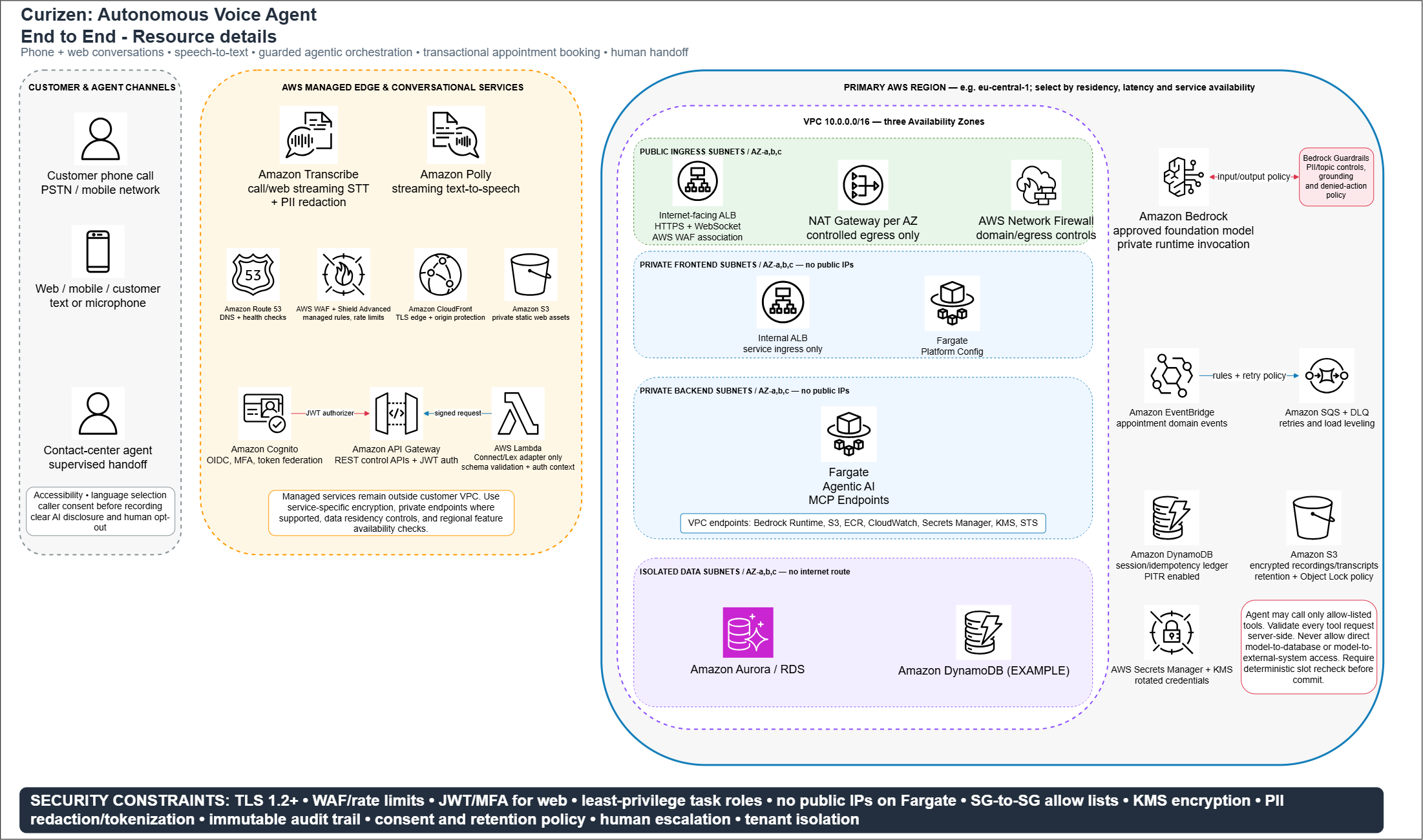
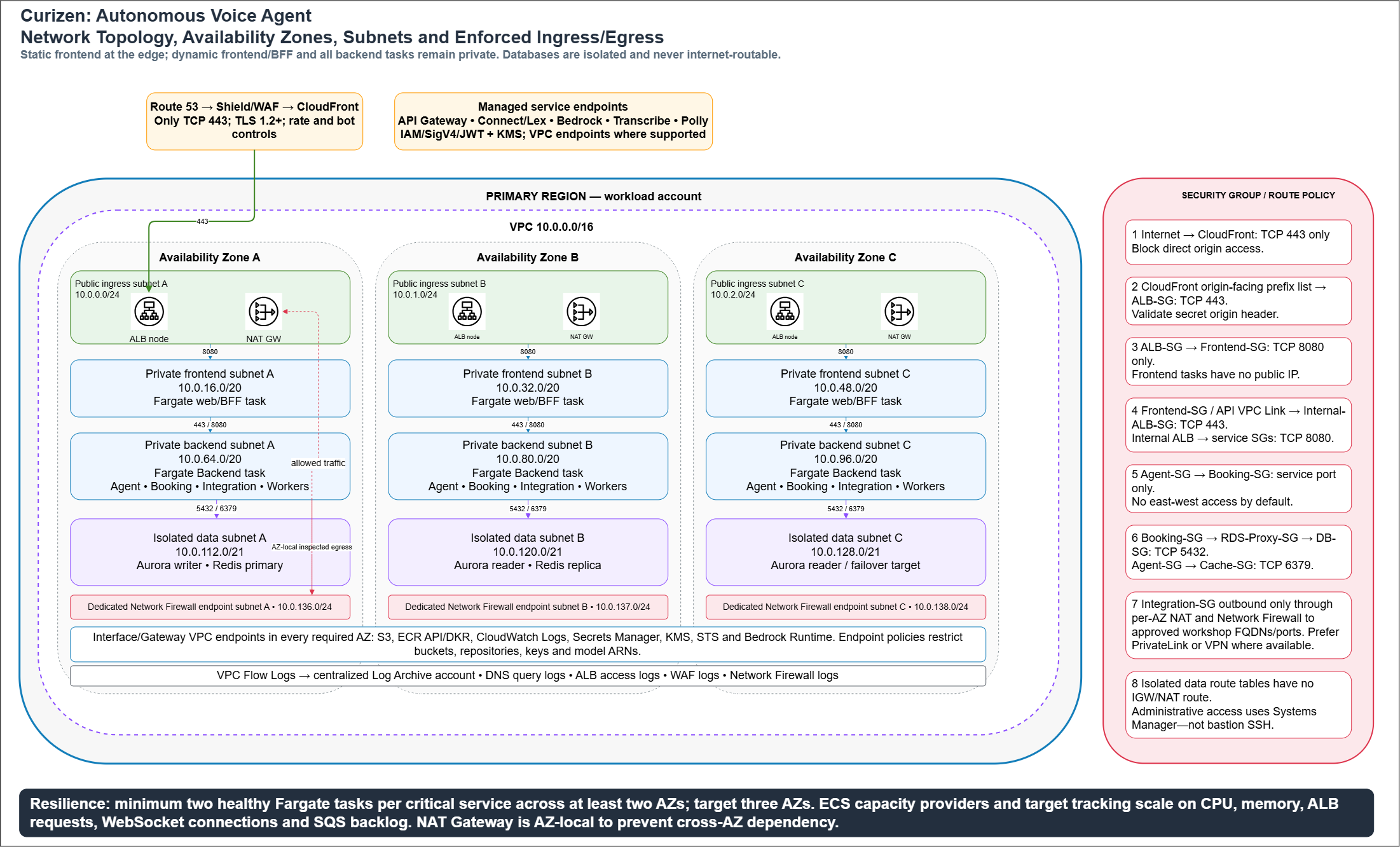
For the Germany POC, hosting region, encryption boundaries and data residency are agreed with you up front, and the deployment operates only within those approved regions.
The platform controls agent configuration. It does not run the agent.
Once configuration is complete, a runtime instance is started that pulls its settings from the platform database, compiles its own copy of the system prompt, and from then on runs independently, with capacity added automatically as load increases.
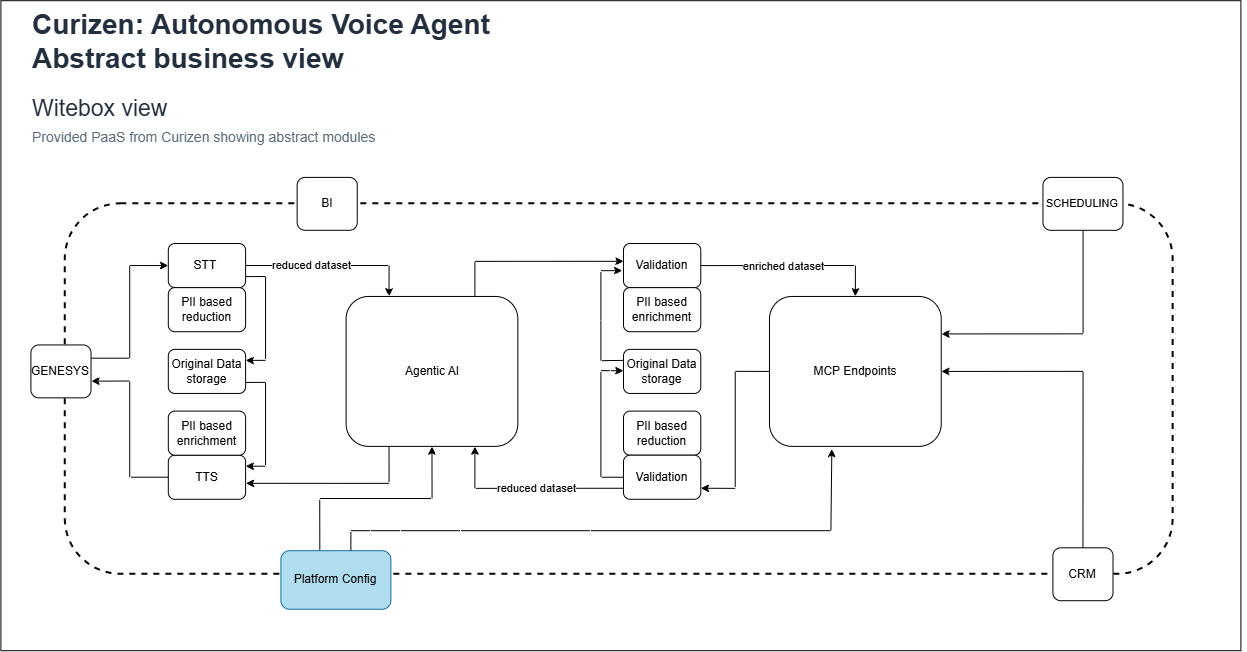
Two flows, always running in parallel
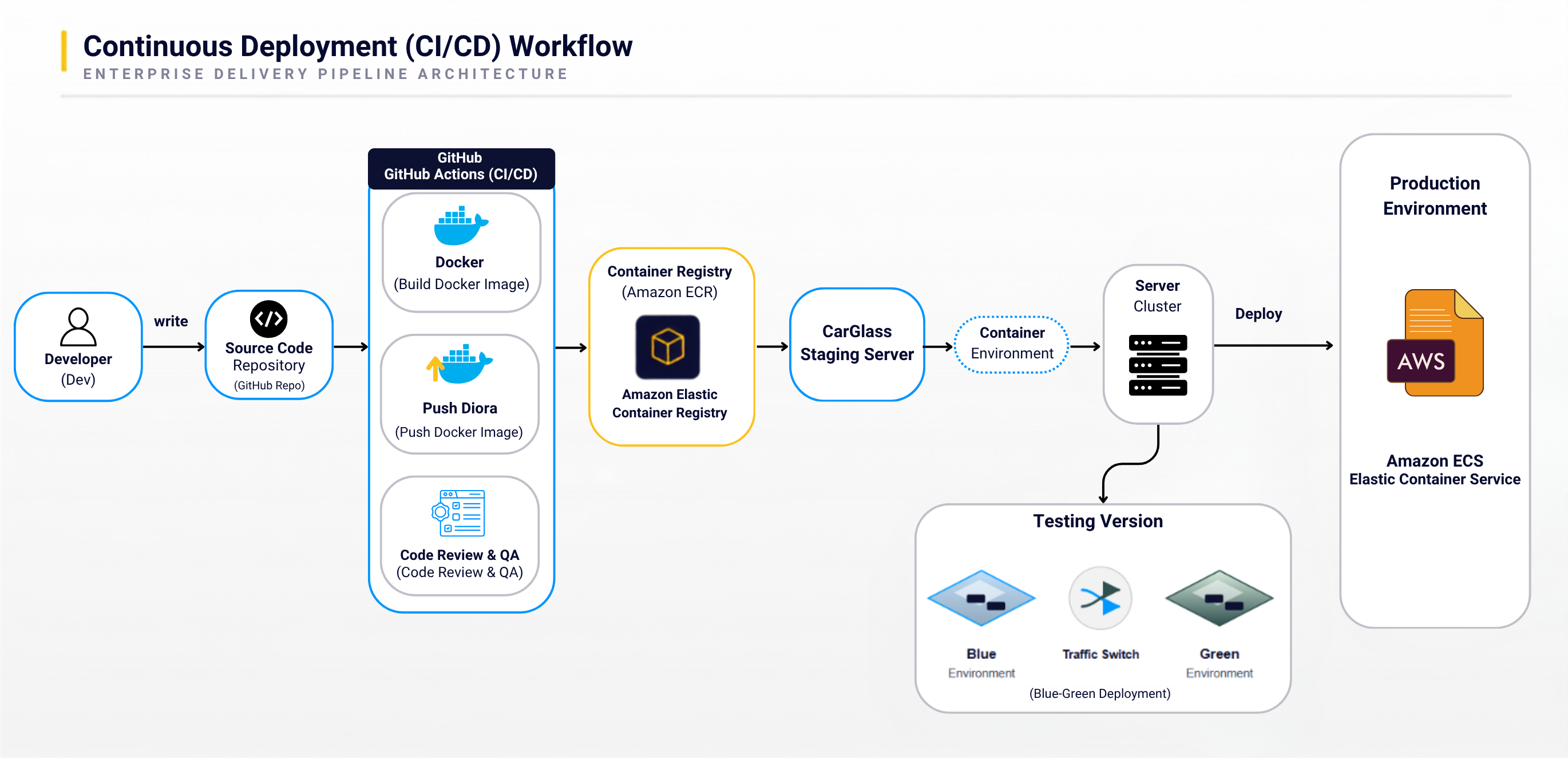
Where each class of data lives
| Data type | Stored in | Owned by | Germany POC position |
|---|---|---|---|
| Agent configuration | Curizen Platform Database | Curizen platform | Region fixed to the agreed EU deployment region |
| Knowledge data | Customer database | Carglass | On infrastructure Carglass controls |
| Conversations | Customer-configured storage | Carglass | Storage target and retention set by Carglass |
| Logs | Defined environment | Customer policy | Separate from conversation content |
Data residency is a deployment choice. The infrastructure region is not fixed by the platform's architecture. Confirming the AWS region for the Germany POC is item 1 of the readiness gate in §07.
Product layer vs. custom build
This section sets out how much of the agent Carglass can change independently after the POC.
The scope is the console surface: sixteen configuration areas, all self-service and all versioned. What sits outside it is a short and specific list.
Everything in the first column below is a configuration screen. Changing it produces a new immutable version, is testable in the Playground, and is publishable and reversible by an authorised Carglass user, with no Curizen involvement and no release cycle on our side.
- Identity & scope: company, department, business role, objective, target audience, working hours, responsibilities, hard limitations
- Prompt Studio: personality (warmth, formality, autonomy, response depth), tone, greeting, response length, technical level, response format
- Behaviour rules: always do / never do / ask permission before / escalate to human when
- Capabilities: enable only what's required: booking, CRM access, payments, human handoff, SMS, email
- Policies: payment confirmation, small talk, call recording, sensitive-data masking
- Knowledge: add documents, websites, text or database sources; chunking, retrieval strategy (semantic / hybrid / keyword), top-K, similarity threshold, reranking, source priority
- Response control: hallucination protection, confidence threshold, fallback behaviour (clarify / cite / hand off)
- Channels: website widget styling, phone, WhatsApp, email
- Versions: compare, publish, roll back
- Users, roles, permissions: view / edit / publish, per product area
- AWS region, encryption boundary and data-residency decision
- Connection of Carglass systems (CRM, calendar, ticketing, help desk, telephony) with OAuth / API key / credential setup
- Tool definitions against Carglass APIs: input schema, output schema, authentication, validation, error handling, approval workflow (AI-assisted import and a basic builder exist; Carglass can create and edit tools thereafter)
- Storage provider and database connection (PostgreSQL, MySQL, SQL Server, MongoDB, Supabase; PostgreSQL optionally as vector store)
- Model and voice provider selection, retention policy per data type, escalation contacts and SLA
- New channel types or providers not on the supported list
- Platform-level features not exposed as configuration
- Bespoke integration patterns that cannot be expressed as a tool schema through the API gateway
- Changes to the runtime, isolation model or platform database itself
Change without engineering, end to end
Security, GDPR, residency and data handling
Encryption, access, masking, retention, deletion and the full subprocessor register, including exactly what each third party receives and what it never sees.
No single control is relied on alone. Data is protected at every layer it passes through, so that one control failing does not mean data is exposed.
Defence in depth: six layers
Call, transcript and log handling
Masking at the point of capture
- User-identifying information is masked in stored conversation records before the record is written, not redacted after the fact.
- A recording can be kept for quality and audit purposes without exposing who the customer was.
Minimising what leaves the platform
- Only the data a specific step actually needs is passed to that step. The language model, the voice provider and any external tool each receive the minimum required, not the full customer record.
- Nothing is sent to an external provider beyond what the configured task requires.
Separation by design
- Agent configuration and customer knowledge sit in physically separate databases, so compromise of one does not automatically expose the other.
- Application, error and access logs are kept separate from conversation content, so operational troubleshooting never requires exposing customer conversations.
Recording is opt-in
- Call recording is a per-agent policy setting, not a default.
- Recordings are only retained where recording is explicitly enabled.
Data lifecycle
Retention & deletion matrix
Every category of stored data has a defined retention period and a defined method of deletion, not a single blanket policy.
| Data | Retention | Deletion method |
|---|---|---|
| Transcript | Per configured policy, matching Carglass's regulatory requirements | Manual on request, or automatic on retention expiry |
| Recording | Per configured policy; only retained where recording is explicitly enabled | Manual on request, or automatic on retention expiry |
| Logs | Operational retention window, separate from conversation content | Automatic on retention expiry |
| Knowledge | Until the source is removed or superseded by Carglass | Manual removal, propagated to every index and cache |
Retention periods are configurable, not hard-coded. Right-to-delete requests are honoured by removing the corresponding data from every store it exists in, including recorded conversations.
GDPR roles
| Party | GDPR role |
|---|---|
| Carglass / Belron | Data Controller: determines the purpose and means of processing its own customers' data |
| Curizen | Processor: processes data on Carglass's behalf, per Carglass's instructions and configuration |
| Amazon Bedrock · ElevenLabs · Amazon Polly | Subprocessors: engaged by Curizen for specific processing functions, under enterprise data-processing terms |
Subprocessor register: who touches what
| Provider | Function | Data access | Region | DPA status |
|---|---|---|---|---|
| AWS | Hosting, compute, storage, networking | Infrastructure-level access only; application data encrypted at rest | Agreed deployment region | AWS DPA |
| Amazon Bedrock | Language model | Only the minimised request context for that turn; no persistent access to platform or customer databases | Agreed deployment region | Covered under AWS DPA |
| ElevenLabs | Conversational voice | Audio / text for the current turn only | Agreed deployment region | Confirmed per subprocessor agreement |
| Amazon Polly | Text-to-speech | Text to synthesise for the current turn only | Agreed deployment region | Covered under AWS DPA |
Access control: who or what can reach what
| Who or what | What they can reach | Control |
|---|---|---|
| A console user | Exactly what their role permits: view, edit or publish, per product area | Role-based permission matrix |
| An external integration | Only the specific API calls it is configured to make | Scoped credentials, per-tool authentication (OAuth, API key) |
| The AI model provider | Only the conversation context and knowledge passed to it for that request | Data minimisation at the request boundary |
LLM & AI governance
Model providers, guardrails, prompt-injection protection, hallucination controls, and an unambiguous position on training.
Model stays inside the deployment
- The language model runs within the customer's own AWS environment, not on a shared external endpoint that pools data across customers.
Enterprise data terms
- Every provider is used under enterprise-grade data-processing agreements that exclude training on customer content. This is a contractual guarantee, not only an architectural one.
No feedback loop
- Conversation data flows one way, into storage and monitoring, and never back into a training pipeline for the underlying model.
Providers used at runtime
Provider and model selection is a configured, versioned setting, reviewed as part of release approval. It is not an implicit runtime default that can drift.
Four named safeguards
Prompt-injection protection
- System instructions and live user input are kept structurally separate, so a customer's message cannot rewrite the agent's underlying rules or permissions.
Guardrails
- The agent operates only within its configured scope, tools and behaviour rules. It cannot act outside what it was explicitly given.
- Active on every deployment, not an optional add-on.
Hallucination controls
- Responses are grounded in retrieved knowledge against a confidence threshold.
- Below threshold, the agent asks for clarification, cites sources, or hands off to a human rather than answering speculatively.
Human oversight
- Behaviour rules define exactly when a conversation escalates to a person. Sensitive, ambiguous or out-of-scope situations are not left to the model alone.
- Risk classification and human-approval requirements are set per agent.
Data minimisation at the model boundary
Monitoring, testing, release & rollback
Every configuration change creates a new immutable version, never an edit to the version already serving customers. Rollback is always to a real, previously-running configuration.
Release management & version lifecycle
Automatic rollback
- Triggered by operational metrics such as error rate, latency and failed tool calls, without waiting for a person to notice.
Manual rollback
- An authorised administrator can roll back to any prior version directly from the console.
- Every prior version stays available, with version compare and change summary.
Testing before anything reaches a customer
Playground
- Text chat and voice simulation against the exact version under review.
- Trace view: retrieved knowledge, tool calls, confidence, latency.
Health gating
- An instance must pass a health check before it accepts any traffic.
- Security validation of credentials, network policy and encryption config runs before deployment.
Version comparison
- Each version stores identity, prompt, policies, knowledge, retrieval and capabilities.
- Compare versions and review a change summary before publishing.
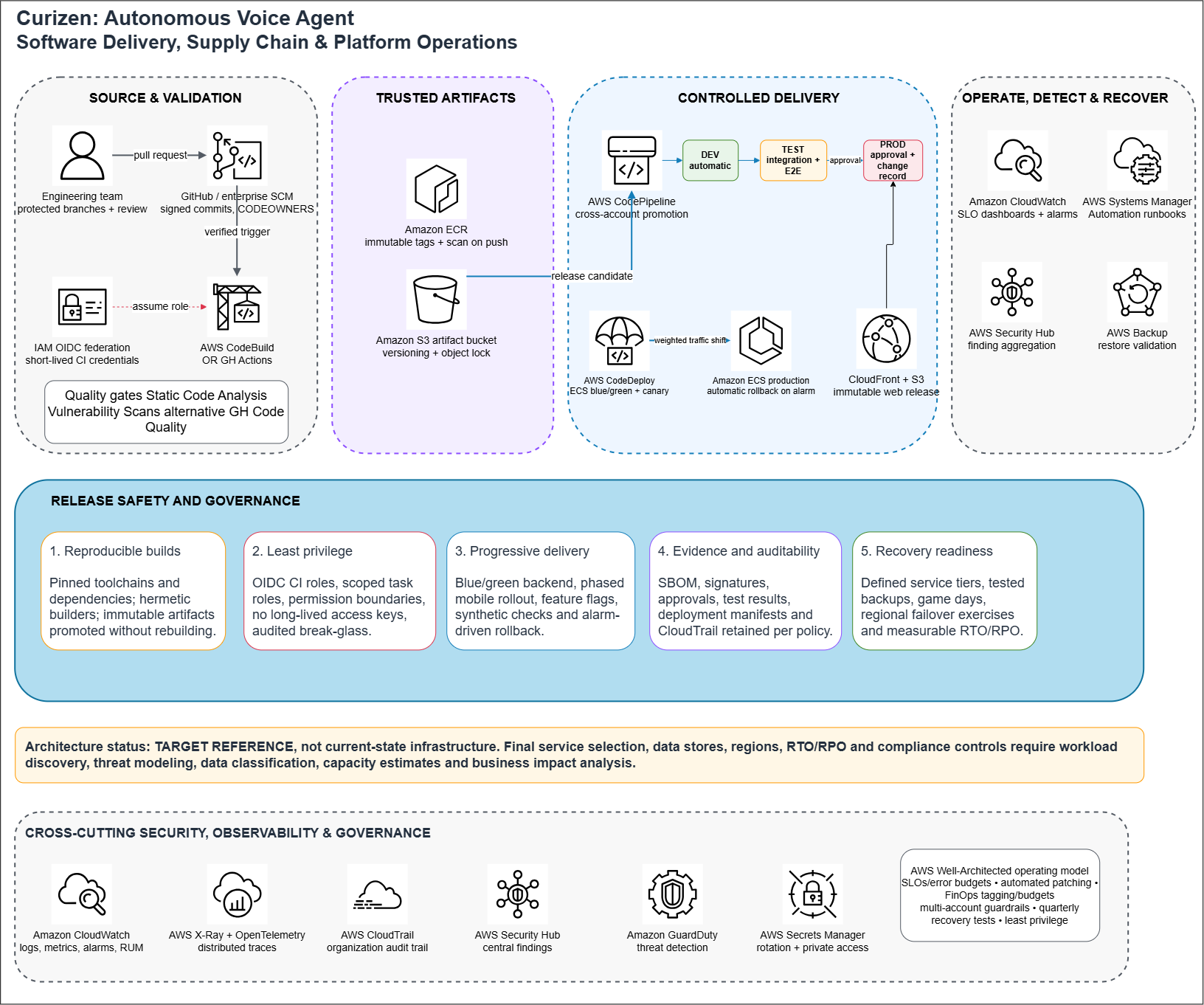
Monitoring & reporting
Conversation-level reporting
- Full transcript, tool calls, knowledge citations and customer satisfaction, per conversation.
- Knowledge quality monitoring: retrieval accuracy, knowledge gaps, source quality.
Infrastructure reporting
- Live table, one row per instance: availability zone, status, CPU/memory, req/min, error rate, uptime.
- Searchable event and log table: scaling actions, health-check results, recovered errors.
- Always references the currently active published version, so it is clear which configuration the running instances serve.
Incident handling & escalation
Planned maintenance is scheduled and communicated in advance, and does not bypass the version-controlled release process.
Integration, handover, IP & support
How the agent reaches Carglass backend systems, how a conversation is escalated to a person, how intellectual property and data ownership are divided, and how support is provided.
API & backend integration
Tool calls and enterprise-system integrations reach the outside world through the same layered path, never a direct connection from the model to an external system.
Tool definition & control
- Input schema, output schema, authentication, validation, error handling, approval workflow.
- Lifecycle: draft → testing → published → disabled → archived.
- Execution logs record input, output, duration and status for every call.
Integration surface
- CRM, calendar, ticketing, help desk, messaging, telephony.
- Authentication by OAuth, API key or credentials.
- Creation by AI-assisted import, basic builder or advanced builder.
Human handover
The escalation policy is configured per agent. Full conversation context transfers with the handover, so the customer never has to repeat themselves.
IP & data ownership
Curizen owns
- The platform, the agent runtime and the underlying framework, which is the software itself.
Carglass owns
- Its own data, knowledge base, conversations and business configuration, meaning everything the platform is configured to hold on Carglass's behalf.
- Anything generated from Carglass's own use of the platform.
Documentation & support model
Documentation
- Developer Center: APIs, SDKs, webhooks and documentation.
- Per-agent configuration is self-documenting through the compiled prompt view and version history.
Support
- A named Curizen contact point for the deployment.
- Escalation: console self-service → platform support → engineering.
- SLA response times agreed per deployment, scaled to incident severity.
- Planned maintenance scheduled and communicated in advance.
Germany POC readiness gates
Before any use of real customer data or any customer-facing exposure, every item below is confirmed and jointly signed off. A partial gate does not permit customer-facing exposure.
- AWS region confirmedDeployment region agreed with Carglass and locked before provisioning.
- Encryption verified end to endIn transit and at rest, across every hop in Fig. 1.
- PII masking confirmed activeVerified before any conversation record is stored.
- Role-based permissions configuredFor all named Carglass users, per product area.
- Subprocessor list & DPA status acceptedReviewed by Carglass data protection.
- Retention & deletion policy configuredPer data type: transcript, recording, logs, knowledge.
- Agent governance settings reviewedRisk classification and human-approval rules for the agreed use case.
- Accuracy & guardrail test pass completedAgainst the agreed use case, evidenced in the Playground.
- Incident & support escalation path confirmedWith named contacts on both sides and agreed SLA.